Monday, 25 November 2013

KEEPING CLEAN: VICTORIAN PUBLIC & PRIVATE BATHS

With very little access to clean water, the Victorian working classes faced an uphill struggle when it came to keeping themselves clean and healthy. They were given a helping hand when the 1846 Baths and Wash-houses Act was passed. This legislation was a response to the successful experiments in providing public baths in Liverpool and the Glasshouse Baths near London Docks. The Act meant that corporations, town councils and parishes could fund the establishment of public baths and wash-houses through the rates, although they could not be forced to do so.

By 1865, numerous large towns had public baths and they were popular wherever they were established. When Coventry's new baths opened in 1852, there were "upwards of 1,000 bathers on the day of opening". At every public baths, there were separate entrances for men and women. Inside were baths with private facilities, as well as public and private plunging and/or swimming baths. All had first and second class options, and in later years, third class was also available.  

Men's Private Baths - Hornsey Road Baths and Wash-Houses (from Living London, 1901)

The Baths and Wash-houses Act fixed the maximum fees bathers could be charged: the lowest class warm bath was 2d, while the cold version was 1d. Open-air baths were also 1d. For this price, they received clean water and the use of a towel. Higher fees were charged for the more superior facilities, which in a first-class private bath might include a carpet, chair, mirror, brush and comb.

The private baths were enclosed in a compartment and they were usually of the 'slipper' type. In many cases, there were no taps inside so the attendant controlled the temperature of the water from outside. In other baths, particularly first and second class ones, the bathers had taps inside the rooms.

An article in Living London (1901) mentions a particular bather who made full use of the bathing and washing facilities: "At Westminster they tell a tale of a certain flower-seller: Every Saturday evening, week in, week out, comes this girl, clad just as she would be when crying "Penny er bunch" on the kerb-stone. She enters from the street by the 'wash-house' door, and proceeds to a private room, where she takes off all her clothes but her skirt and jacket,, and puts her front locks into curlers. Then she hires a trough, mangle, etc. for an hour, submits her underwear to the cleansing process, finally hanging it up to air; that done, she buys a ticket for a twopenny hot bath, bathes herself, puts on her clean clothes, combs her fringe, and for the expenditure of threepence-halfpenny emerges as good an imitation of 'new woman' as anybody else could compass at any price!"

Teaching Schoolboys to Swim - Kensington Baths (from Living London, 1901)

For those who could afford it, the ultimate in luxury was the Turkish bath which were available in most large cities. According to Living London, "it is practised in perfection at the Hammam (or Turkish bath) in Jermyn Street, St James's. It costs four shillings, and it takes two hours; but nothing yet invented by Londoners, or annexed from abroad, has ever come near the delicious experience or the restorative quality of the Turkish bath. One enters, a world-weary wreck, tired from travelling, working, pleasuring, maybe, rheumatic; one sits, or reclines, in a succession of hot-air rooms, each of the eight hotter than the last - varying from 112 degrees F to 280 degrees F - until a sufficient perspiration has been attained."

Turkish Bath, Jermyn Street - Shampooing Room (from Living London, 1901)

"Then one is conducted to the shampooing room, and whilst reposing on a marble slab, one is massaged by light-handed attendants. That process is followed by a series of brushes and different soaps; and after a variety of shower douches and a plunge into cold water, the bath is complete. A sojourn in a lofty cooling room, a quiet smoke, or a light meal, and one sallies forth to a new being. A visit to the gallery of the attendant hairdressers makes perfection more perfect."


Turkish Bath, Jermyn Street - Cooling Room (from Living London, 1901)

Living London recommended the vapour bath (obtainable at the Marylebone and a few other public baths) as "an excellent substitute for the Turkish should limited time be a consideration. Various medicated baths are also used by a section of Londoners - such as pine, bran, sulphur - to cure certain ailments, as alternatives to foreign springs, etc. whilst electricity is impelled through the water at the request of some others. This sort of bath is occasionally used in conjunction with the Swedish system of treatment (massage and exercises by means of mechanical appliances), now much practised in the Metropolis."

While these luxurious Turkish and vapour baths were beyond the reach of the working classes, those in regular employment could afford to use the public or private baths once a week. As The Graphic reported, "At the cost of a pint of the commonest beer, the working man may enjoy an invigorating swim or a wholesome cleansing in a private warm bath."

Monday, 18 November 2013

IN SUSPICIOUS CIRCUMSTANCES: VICTORIAN CORONERS' INQUESTS

I can spend hours browsing Victorian newspapers, especially now that so many are online through The British Newspaper Archive. They tell us so much about the social history of that time through the news reports, the personal columns and the advertisements. These publications also reveal a great detail about the Victorians' appetite for gossip and scandal! 

Look at any Victorian newspaper from across the UK and you're almost guaranteed to see a report of a suspicious death: perhaps a suicide pulled out of the river, or a murder victim found in an alleyway with his throat cut, or simply someone who had been run over by a cart in the street. Have you ever wondered what happened next?

Whether the death occurred in Liverpool or London, Manchester or Malvern, in every case, the procedure was the same. Once the police had reported a suspicious death to the coroner, he would summon a jury and investigate how the deceased died by interviewing members of the family and any witnesses, as well as viewing the body.

Police Ambulance Entering a Mortuary from 'Living London' (1901)

In the Victorian period, coroner's inquests were frequently held in public houses because there was a table large enough for a body and there was space for the jury of twelve, plus the coroner and witnesses. Sometimes, inquests were held in the home of the deceased or in the open air. It was not until the latter part of the nineteenth century that coroners' mortuaries started to appear, especially in large cities. Dedicated coroners' courts were also founded at about the same time.

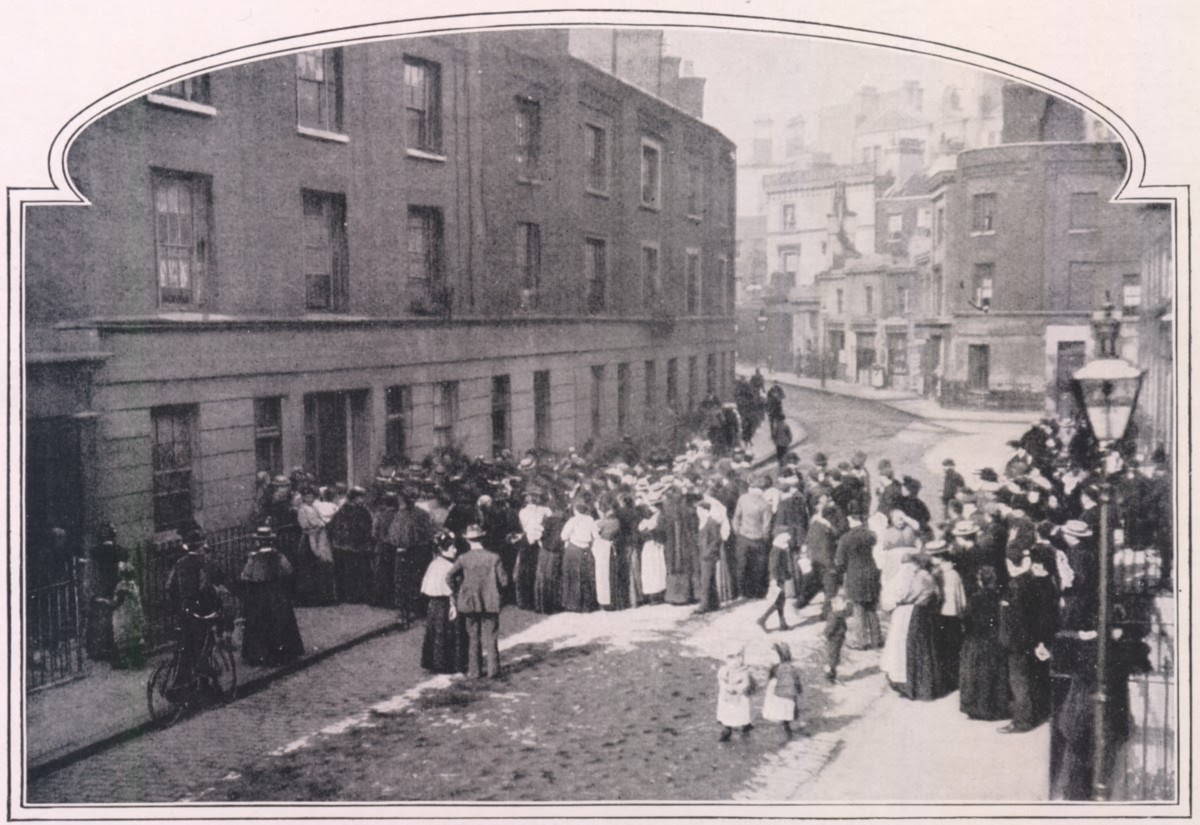
Here's proof of the Victorians' love of a spectacle and how quickly the rumour mill could spring into action. This picture shows an excited crowd outside a London coroners' court, awaiting the verdict on a local man who had been shot dead:

From 'Living London' (1901)


By 1901, when these photographs were taken for an article in 'Living London', a formal system of coroner's inquests was in place in large towns and cities. At this time, the jurors received "two shillings a day for their labours and are chosen from the Parliamentary voting lists, the occupants of each street being tackled in turn." Their attendance could be enforced "for the entire day if needs be, and if eight inquests are on the list they must return eight verdicts".

Here's an image of jurors waiting to go inside to view a body:

From 'Living London' (1901)


The article also described a typical scene inside a London coroner's court: "At a large table are seated the reporters; in the centre is the witness-box; while at the back are rows of chairs which are occupied by members of the public - dishevelled women, curiosity-mongers, and the like - and those witnesses who are able to control their feelings. Witnesses who are inclined to be hysterical are confined to the waiting-room - if there happens to be one - until they are required to give evidence."

After the jury took their oaths, they left the court and filed into the mortuary to view the body or bodies. This being done, they returned to court and the witnesses were examined by the coroner. When all the evidence was heard, the jury delivered their verdict, after which the coroner signed a burial form to enable the family of the deceased to lay their loved one to rest.

This view of the inside of a coroner's court clearly shows the witness box, the coroner, the jury and the reporters scribbling away:

A Coroner's Inquest from 'Living London' (1901)  
 The outcome from this inquest would have been printed in all the local newspapers, ready for an eager public to speculate and gossip over - and for us to do the same more than 100 years later!

Monday, 11 November 2013

VICTORIAN CRIMINALS - TRICKS OF THE TRADE

If you were to visit Victorian England, especially one of the large towns, it wouldn't be long before you saw a police officer clad in blue (nicknamed 'bluebottles'). They had the unenviable job of trying to keep order on the streets - a job which was tough, dangerous and definitely not for the fainthearted. As a fan of Ripper Street, the BBC1 TV series, it's been fascinating to find out more about the methods used by Victorian detectives in gathering evidence, finding witnesses and tracking criminals.

That's why I was so interested in an article I recently found in the periodical Living London (1901) about New Scotland Yard. In it, mention is made of the Yard's Black Museum which was 'more than a collection of grim and ghastly curiosities [or] the relics of celebrated crimes'. It was described as a place where 'the detective police officer, anxious to improve himself professionally, will find much useful information'. This was because he could study the methods of criminals through the implements and tools which formed the exhibits:

'Here are the "jemmy", the screw-jack, the rope ladder (Peace's), light and easy of carriage under an overcoat, the neat dark lantern made out of a tin matchbox, the melting pot and ladle of the coiners, with mould and other apparatus used by them; together with relics that reveal the more elaborate processes of the banknote forgers, such as copper plates, burins, lithographic stones, and so on.'

I can just imagine the real-life versions of Inspector Reid, Sergeant Drake and Detective Sergeant Flight visiting the museum in the early stages of their careers (the Black Museum was opened in 1875). They might have seen the ingenious burglar's folding ladder:

Burglar's folding ladder. From 'Living London' (1901)

Or the burglar's pockets for holding his tools:

Burglar's pockets for holding the tools shown below them. From 'Living London' (1901)


Or the knuckleduster:


Or the coiner's moulds and tools:

Coiner's implements including rack for holding coins during plating process, melting pot, ladle, polishing brush, etc. From 'Living London' (1901)

Coiner's moulds showing spring to hold them together. From 'Living London' (1901).

Finally, as the Black Museum was open to the public, they may also have seen other visitors. Here's a view of a couple examining the display cases, with a police officer on hand to tell a few stories, no doubt. There is a row of death masks at the back. One of the ropes on display was used by cook Marguerite Dixblanc to drag the corpse of her murdered mistress into the scullery.

Thursday, 31 October 2013

VICTORIAN PATENT MEDICINES

Imagine if you could visit Victorian England and take a sneaky peek inside the cupboards of an ordinary house - and wouldn't we all love to do that! Chances are you'd find numerous pills and potions designed to treat every ailment under the sun. The Victorians constantly worried about their health and that of their family - for good reason. Epidemics of infectious diseases came and went in never-ending cycles of typhus and typhoid, cholera, smallpox, measles and scarlet fever. Add in respiratory diseases like tuberculosis, which were the major killers from the 1880s, and you get a good idea of how unhealthy it was to live in Victorian England. Even catching a simple chill could lead to a more serious, life-threatening illness. 

It's no wonder, then, that the Victorians lapped up the claims of drug manufacturers to cure all ills. The newspapers were full of advertisements proclaiming the success of X, Y and Z to treat conditions like skin diseases, gout and digestive complaints. Many of the Victorians' 'tummy' problems were probably a result of food adulteration, such as the addition of alum, ground bones and plaster to bread, and the extra ingredients of vitriol and cocolus indicus in beer. For the wealthy upper classes who ate large meals made up of multiple courses, indigestion was inevitable. 

Patent medicines became hugely popular to solve digestive complaints and one of the most well-known examples was Holloway's Pills, invented by Thomas Holloway, the son of a baker. Advertisements claimed the pills could 'strengthen the stomach, and promote the healthy action of the liver, purifying the blood, cleansing the skin, bracing the nerves and invigorating the system'. 

Here's the front of a trade card for Holloway's Pills and Ointments:

And here's the reverse with Holloway's claims for what his medicines could treat:

The pills and the ointment were hugely successful, not just in Britain but across the Empire. They made Thomas Holloway a multi-millionaire and when he died in 1883, he had amassed a personal estate of £596,335 plus freehold properties. After his death, the pills were analysed and found to contain nothing more than aloe, saffron and myrhh - a traditional herbal remedy.

Wednesday, 23 October 2013

VICTORIAN SHOPPING IN BIRMINGHAM, 1876

Last week, the Victorian Silver Arcade in Leicester was finally re-opened after years of restoration. Shopping arcades across Victorian Britain were built to a similar design with an open central archway and two floors, although unusually the Silver Arcade had four storeys. The buildings were extremely decorative inside with lavish use of lighting, glass and high quality materials. The aim was to attract upper-class customers with plenty of money to spend. 

Birmingham's Great Western Arcade is an excellent example. Opened to the public on 28 September 1876, it was built over the tunnel of the Great Western Railway running from Monmouth Street to Temple Row. On 2 December, the Illustrated London News reported on the new building:

"The shops, of which there are forty-two on the ground floor and forty-two on the balcony, are mostly let, and almost every trade will be represented. Some London firms have taken shops here. The fronts are ebony and gold, and have been made by Mr F Sage, of Gray's-inn-road, London. The arcade is 400ft. long and commodiously wide and is 40 ft. high. The dome is 75ft. from the top to the floor."  

Here is a view of the exterior of the Great Western Arcade:

The New Great Western Arcade, Birmingham (Illustrated London News, 2 December 1876)

As you can see, carriages frequently transported wealthy customers to the arcade. They could instruct their coachmen to drop them off outside and to return within a specified amount of time. 

Inside, no expense was spared to impress the shoppers, particularly with the lighting scheme:

"The galleries are illuminated by forty-four four-light candelabra, making 176 lights in all. Beneath are forty-four three-light hanging pendants, or chandeliers, whilst in the centre of the building, immediately under the dome, is suspended a colossal chandelier, 14 ft. high and 8 ft. in diameter, comprising two tiers of lights, the upper one consisting of eighteen jets and the lower one twenty-four. Thus the body of the arcade is lighted by 350 gas jets, the whole of which are enclosed in opal globes, shedding a mellow light on the building. When the 600 lights are lit the effect is magnificent."

 Here's a view of the interior, which gives a good illustration of the lights and the dome above:

The New Great Western Arcade, Birmingham (Illustrated London News, 2 December 1876)


I wonder if the gas bill was as colossal as the chandeliers!

Tuesday, 15 October 2013

WHAT TO WEAR: 1885

While researching my forthcoming book, A Visitor's Guide to Victorian England, I came across hundreds of fascinating stories in newspapers, contemporary periodicals and original sources. Many of them did not make it into the book so I'd like to share them with you on this blog.

One of the most interesting aspects of Victorian England is the fashion, probably because it's so different to modern-day clothing. In fact, I first became interested in this period in history after having fun dressing up in replica Victorian costumes at Morwellham Quay in Devon.

Then, as now, young ladies liked to wear up-to-the-minute clothing and they pored over fashion plates in magazines straight from Paris. One of the regular features in Cassell's Family Magazine was 'What to Wear: Chit-Chat on Dress From Our Paris Correspondent'. The writer offers highly detailed, no-nonsense advice to look good on a budget. Here are some of her suggestions for October 1885:

"If any of you are in doubt about a becoming, useful and dressy autumn gown, let me advise you to choose a grey beige. Have a habit bodice bordered with close-set rows of silver braid, and a waistcoat of silver braid; arrange the skirt with wide box-plaiting, having seven rows of the braid an inch from the edge, and draperies above bordered in the same way. You will then have a gown that will stand any amount of wear and tear, that will wash like a piece of calico, and cannot fail to be ladylike and in good style."

Here's a pic from the article:

Cassell's Family Magazine, October 1885

You'll notice that the style of dress in the mid 1880s created an hourglass silhouette. The writer of the article stressed that dresses "should fit glove-tight, and to effect this, and begin at the beginning, the stays must be good." Another option was to "wear inside the lower portion of the stay a semi-circular nickel plate, which is supposed to compress backwards, and not downwards, and therefore is less hurtful."

To me, wearing stays (or corsets) still sounds downright uncomfortable! It might be why the lady on the left of the picture below holding the ball can't bend down...

Cassell's Family Magazine, October 1885